
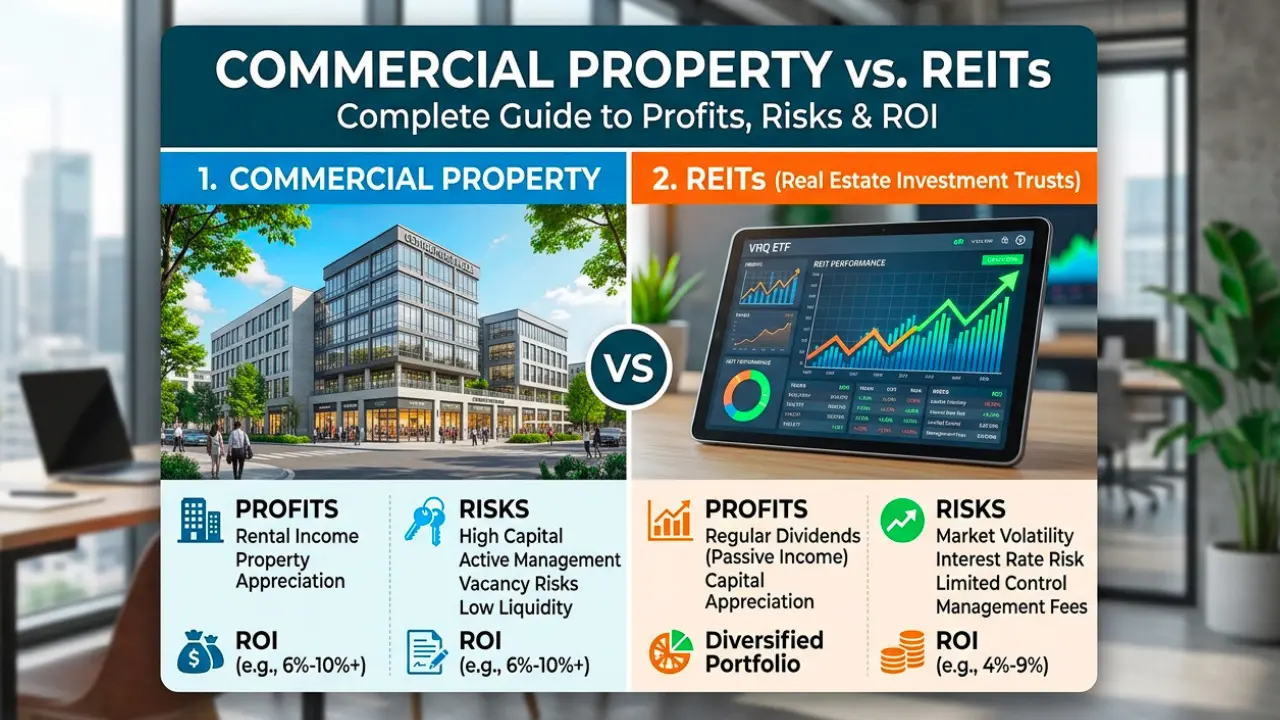
Investing in real estate has long been the "gold standard" for building wealth. For decades, if you wanted to get into the game, you needed a massive bank balance, a lawyer, and the patience to manage bricks and mortar. However, the rise of REIT investing has flipped the script, making commercial real estate accessible to almost everyone.
But with new opportunities come new questions. Is a 6% REIT dividend better than owning a physical shop? Or what happens to my investment if a major tenant leaves? In this guide, we’ll break down the pros and cons of REIT vs commercial real estate investment using real-world facts and user concerns to help you decide where to park your money in 2026.
Table of Contents
What is REIT investing?
Think of a REIT (Real Estate Investment Trust) like a mutual fund for property. Instead of buying one shop, you buy shares in a trust that owns a massive portfolio of commercial real estate like tech parks, malls, or data centers.
In the context of commercial real estate investment in India, REITs are evolving. By early 2026, regulatory shifts have reclassified REITs as equity-related instruments, making them more liquid and accessible.
Why prefer REITs:
-
The Low Entry Barrier: You don't need crores. You can start with small amounts through your broker.
-
Diversification: You don't have to worry if one office is empty because the REIT owns 20 others.
Dividend Payouts: By law, REITs must distribute 90% of their net income to investors.
Direct Commercial Property Investment
This is the traditional path. You buy a physical asset, perhaps a retail shop in a busy market or an office space in a business hub like Mumbai or Pune. You are the landlord; you hold the deed and collect the rent.
Common Concerns:
Direct commercial real estate is alluring but "tricky."
-
Vacancy Risk: A common concern in commercial real estate is the "dark period." If a tenant leaves, a commercial space can sit empty for 6–12 months, during which you still pay maintenance and taxes.
-
LVR & Deposits: Unlike home loans, commercial loans often require a 30–40% down payment.
-
The "Lump Sum" Factor: You need a significant upfront investment (often ₹30 lakhs to ₹1 crore+).
REIT vs Direct Property Investment: The Comparison
To understand the difference between a REIT and owning property, look at this snapshot:
|
Feature |
REIT Investing |
Direct Commercial Property |
|
Initial Investment |
Low (₹50,000 or less) |
High (₹30 Lakhs+) |
|
Liquidity |
High (Sell like a stock) |
Low (Takes months/years to sell) |
|
Management |
Professional Team |
Self-managed (Active work) |
|
Taxation |
Complex (Dividends vs. Interest) |
Standard Rental Income & LTCG |
|
Control |
None (Trustee decides) |
100% (You decide) |
|
ROI Potential |
Steady (8–12% total return) |
High (Appreciation + 7% Yield) |
REITs vs Direct Commercial Property Investment: Which is Better?
The answer depends on your "investor personality."
1. The Passive Income Seeker
If you want a "set it and forget it" style, REIT investing is the winner. Users on financial forums highlight that REITs are perfect for diversifying away from just "Gold and FDs." You get a piece of grade-A office parks that would otherwise be impossible to own individually.
2. The Wealth Builder
If you want to build a legacy, direct commercial property investment is often preferred. While it is less liquid, you benefit from capital appreciation. A shop in a prime location can triple in value over a decade, something REIT share prices rarely do as aggressively because they pay out most of their cash.
Emerging Trends & Real-World Facts for 2026
The landscape is shifting, and if you're looking at commercial real estate investment in India, keep these 2026 trends in mind:
-
SM-REITs: Small and medium REITs are now allowing people to invest in specific high-value properties with smaller ticket sizes (around ₹10 lakhs), bridging the gap between the two worlds.
-
The "Data Center" Boom: With AI growing, properties housing data centers are seeing the highest rental growth.
-
Strategic Hubs: New commercial projects in Mumbai and Pune are focusing on "flex-leasing" to reduce vacancy risks. For instance, projects like Shapoorji Pallonji Heartland in Mulund are attracting interest because they are backed by trusted developers, reducing the "construction risk" that users on Quora often warn about.
The Risks You Should Consider
-
REIT Taxation: A big concern on India Investments is the multi-layered tax. REIT income is split into "dividend," "interest," and "repayment of debt." Each is taxed differently, which can be a headache during ITR filing.
-
Direct Property Maintenance: In a direct deal, you are responsible for everything. As one Reddit user warned, "Nobody falls in love with a warehouse. If it’s not making money, it’s just a liability."
Hybrid Strategy: The Best of Both?
Many savvy investors are no longer choosing one over the other. They use a "hybrid model":
-
Direct investment for long-term growth (e.g., buying commercial shops).
-
REITs for liquidity and immediate cash flow.
Conclusion
There is no "perfect" investment, only the one that fits your goals. If you have the capital and the stomach for management, commercial real estate offers unparalleled control and growth. If you want the benefits of property without the "landlord headaches," REIT investing is your best bet. Before you jump in, especially with new commercial projects in Pune or Mumbai, always consult an expert. Real estate is a long game, make sure you're playing it with the right tools