
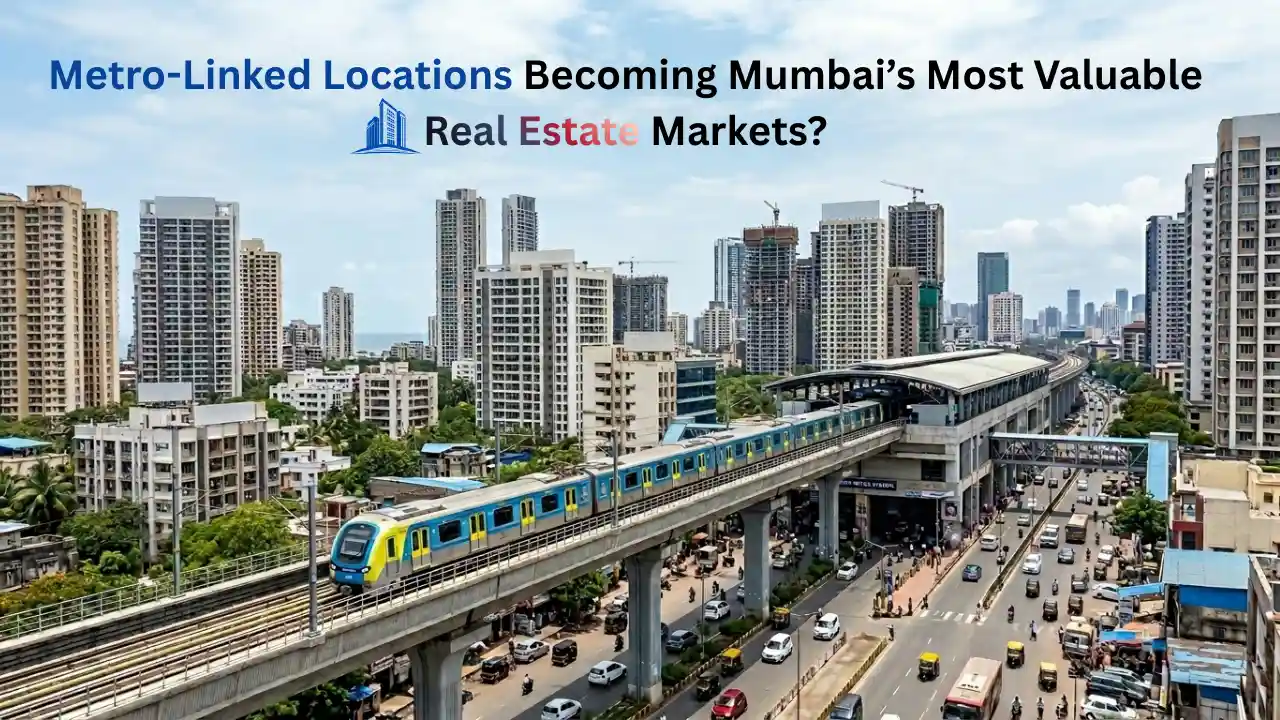
Mumbai has always been a city where real estate follows one simple rule: connectivity drives demand. Earlier, properties near railway stations and highways dominated the market. Today, a new force is changing the city’s property landscape faster than ever before the Mumbai Metro.
From Andheri and Ghatkopar to Dahisar, Chembur, and even Panvel, metro connectivity is transforming how people choose homes and where investors put their money. Areas once considered “too far” are now becoming some of the most preferred residential and commercial destinations.
In simple words, metro connectivity is no longer just a convenience. It is becoming a major real estate pricing engine. The biggest proof? Rising Mumbai metro property prices across almost every operational and upcoming metro corridor.
Table of Contents
Why the Metro Is Different From the Local Train
Mumbai's local train network built the city as we know it. Andheri, Dadar, and Borivali grew because of railway connectivity. But the local train system is overcrowded, often delayed, and doesn't reach many newer residential and commercial zones.
The metro is solving that problem.
It's faster. It's air-conditioned. It runs on time. And most importantly, it's reaching corridors that the local train never served like the Andheri–Ghatkopar belt, the western suburbs from Dahisar to DN Nagar, and soon, the underground corridor from Colaba all the way to SEEPZ.
For working professionals, this is life-changing. And wherever life changes, real estate follows.
Today, people are actively searching for:
-
Property near metro stations
-
Faster commute options
-
Better rental demand
-
Future appreciation zones
-
Affordable suburbs with connectivity
This is exactly why metro-linked locations are becoming some of Mumbai’s most valuable real estate markets.
How Does Mumbai Metro Affect Real Estate Demand?

One of the "most common questions buyers ask today" is, "How does Mumbai Metro affect real estate demand?"
The answer is simple - The metro cuts commute time. And in Mumbai, commute time is everything.
When a suburb that used to be "45 minutes from work" becomes "20 minutes from work," it suddenly becomes desirable. Buyers who were priced out of areas closer to their office start looking here. Investors who ignored this pocket start paying attention.
Here's the standard pattern that plays out every time a metro line is confirmed:
Stage 1 — Announcement: Prices inch up. Investors enter early. Developers quietly acquire land.
Stage 2 — Construction: Mid-level appreciation kicks in. New project launches begin in the area. Buyers start taking the locality seriously.
Stage 3 — Operations: Real jump happens. Rental demand rises sharply. Buyers pay a premium for walkable metro access. Commercial spaces see more footfall.
This three-stage playbook has already played out fully with Metro Line 1 (Versova–Andheri–Ghatkopar), and it's currently unfolding across multiple other corridors.
Earlier, people preferred staying close to railway stations. Now, metro accessibility is becoming equally important, especially among working professionals and younger homebuyers.
A metro station within walking distance has become a major property advantage.
Which Suburbs Are Growing Because of Metro Connectivity?
Let's go corridor by corridor, because not all metros impact prices equally.
Metro Line 1: Andheri–Ghatkopar
This is the proof of concept. Running since 2014, this line connected the western and eastern suburbs for the first time without depending on slow road traffic.
Ghatkopar went from being a "middle-class eastern suburb" to one of Mumbai's most sought-after residential and commercial zones. Property near metro stations in Mumbai doesn't get a better case study than this.
Today, Ghatkopar commands rental premiums that beat many western suburb pockets. Andheri East has seen significant redevelopment, with old chawls making way for new residential towers.
Metro Line 2A: Dahisar to DN Nagar
This line opened a new story in Mumbai's western belt. Areas like Dahisar East, Borivali, Kandivali, and Malad suddenly had metro connectivity to the Andheri business district without depending solely on the Western Express Highway.
What followed? Increased demand for 1 BHK and 2 BHK units. Higher interest from salaried professionals. Projects that were sitting unsold started moving.
For buyers looking at the best areas near the metro for investment, this corridor still has room to grow, especially in Kandivali and Dahisar pockets, where prices haven't peaked yet.
Metro Line 7: Andheri East to Dahisar East
This is one of the more underrated lines. It covers the traffic-heavy WEH stretch and connects Andheri East home to MIDC and major corporate campuses to residential zones further north.
The impact? Andheri East has become significantly more premium. Borivali and Kandivali are seeing new project launches at a pace not seen before. And buyers are openly willing to pay a 5–10% premium for societies within walking distance of a metro station.
Metro Line 3: Colaba–Bandra–SEEPZ (The Underground Game-Changer)
This is the big one.
Metro Line 3 connects South Mumbai, Worli, BKC, the airport zone, and SEEPZ in one underground corridor. Think about what that means: you can get from Colaba to BKC without a cab or a crowded road. You can get from Andheri East to Lower Parel in under 20 minutes.
The impact on Bandra Kurla Complex metro property rates is already visible. BKC was already expensive, but Metro Line 3 has made it even more of a magnet for corporates and professionals. Lower Parel, Worli, and Santacruz are all seeing fresh interest.
For commercial real estate in particular, this line is massive. Office leasing decisions are increasingly being shaped by proximity to Line 3 stations.
Metro Connectivity Is Also Boosting Commercial Real Estate
The metro’s impact is not limited to residential housing. Commercial real estate is also changing rapidly. Businesses today prefer offices with better employee accessibility. Companies know that an easier commute improves productivity and employee satisfaction.
This is why metro-connected office zones are becoming more attractive.
Commercial areas benefit strongly:
-
BKC
-
Andheri East
-
MIDC
-
SEEPZ
-
Lower Parel
-
Ghatkopar
-
Chembur
Metro connectivity is helping businesses move beyond traditional CBD locations.
Rental Markets Are Growing Faster Near Metro Corridors
One of the quickest impacts of metro connectivity can be seen in Mumbai’s rental market.
Tenants react immediately to convenience.
Properties within walking distance of metro stations often attract the following:
-
Faster occupancy
-
Higher rents
-
Better tenant retention
Young people today typically prefer to live in metro-connected communities because they cut down on the amount of stress caused by commuting every day.
The result of this has been an increase in rental income for landlords of properties located near metro rail lines. This is particularly true in Andheri East, Ghatkopar, Borivali, and Chembur.
Affordable Housing Is Expanding Because of Metro Connectivity
More affordable housing options are now being opened up due to being connected to the metro. Although properties in central areas of Mumbai are quite expensive, potential purchasers are more easily able to purchase in the cities' outer areas due to the connection to the metro.
Suburbs that were previously considered undesirable because they were too far from the center are now an option for many buyers. Young couples and first-time buyers (those who previously might have had to compromise on where they wanted to live) are now able to confidently purchase in these connected outer suburbs.
People who previously would not have considered living in outer suburbs are now doing so because traveling by metro makes their commute easier.
This is one of the biggest reasons affordable housing demand is rising in outer Mumbai regions.
Navi Mumbai and Panvel Are Becoming the Next Big Story
One of the most exciting investment stories is now developing in Navi Mumbai and Panvel. Infrastructure growth combined with metro expansion is creating long-term investment potential.
Why is Panvel attracting investors?
Because it connects with:
-
Upcoming metro routes
-
Navi Mumbai International Airport
-
Mumbai Trans Harbour Link
-
Industrial and IT corridors
Many investors now see Panvel as a future growth hub.
The expectation is clear:
-
Better infrastructure
-
Higher future appreciation
-
Strong housing demand
-
Rising commercial activity
This is why Panvel is increasingly becoming one of the best areas near the metro for investment in the Mumbai Metropolitan Region. Investors looking at a 5–10 year horizon are already entering Panvel. Mid-income housing is seeing strong demand from IT and industrial professionals who work in Navi Mumbai but want newer, larger homes at prices that South Mumbai and the Western Suburbs simply can't offer.
Panvel, Navi Mumbai metro real estate, is shaping up to be one of the most significant investment stories of the next decade.
What Should Buyers Check Before Investing Near Metro Stations?
Buying near metro corridors can be highly rewarding. But smart evaluation is important.
Before investing, buyers should check:
Walkable distance (under 500 meters): Highest value. The premium is justified.
Close but not adjacent (500m–1km): Strong appreciation, usually without the noise concerns of being right next to the track.
Too close to the elevated track: Can have noise and privacy concerns. Worth investigating before buying.
Beyond distance, check:
-
Is there a future corridor extension planned nearby?
-
What's the developer's track record?
-
Is the project RERA registered?
-
What's the current rental yield benchmark for that micro-market?
Investing in real estate near a metro station isn't merely about proximity; it's also about choosing the location wisely.
The Bigger Picture: Mumbai Is Being Redrawn
In the past, real estate agents advised their clients that "the closer to south Mumbai, the better." That advice no longer holds up.
Thanks to the metro's connectivity, wherever you live right on Ghatkopar feels like you're living within the confines of BKC, thus making it much easier to commute from Ghatkopar to BKC as opposed to commuting from Worli five years ago. A tenant renting a flat in Borivali should feel just as comfortable renting from Andheri as they would have without the metro's service.
The pricing for real estate in Mumbai with metro connectivity has changed dramatically and now reflects an evolution of urban development throughout the city of 20 million residents into areas with value to grow over the next ten years.
The corridors have been laid out. The stations have all been built and are operational. The only thing left is for you to determine whether or not you live in an advantageous position relative to your chosen location.
Final Thoughts
Mumbai Metro is shifting the property market in a lasting way. More parts of the city that were previously seen as secondary markets are now being viewed as premium investment areas. People are focusing more on how well an area is connected than ever before, and it is widely known that investors are tracking new metro lines very closely. As a result, most developers are launching their projects in a strategic manner around metro station locations.
As we move forward in time, areas with metro access will be an increasingly significant part of Mumbai's overall real estate value trend. The bottom line is that this new trend offers home buyers an opportunity to get into new metro-connected areas before property values rise significantly.
Metro access also provides one of the best long-term returns on investment within the Mumbai real estate market for investors.
If you are interested in looking into investment opportunities with metro access or considering upcoming projects or verified properties located in Mumbai or Navi Mumbai, explore Keystone Real Estate Advisory and see all the projects related to the next phase of infrastructure development in Mumbai.
FAQs
1. Does metro connectivity increase property prices in Mumbai?
Yes. Properties located near metro stations often see higher demand, better rental yields, and stronger long-term appreciation compared to areas without metro access.
2. Which Mumbai areas have benefited the most from metro connectivity?
Areas such as Ghatkopar, Andheri East, Dahisar, Kandivali, Borivali, Chembur, Lower Parel, BKC, and parts of Navi Mumbai have witnessed significant real estate growth due to metro expansion.
3. Is buying property near a metro station a good investment?
In many cases, yes. Metro-connected properties tend to attract more buyers and tenants, making them appealing for both capital appreciation and rental income.
4. Does metro connectivity improve rental demand?
Yes. Tenants, especially working professionals and students, prefer homes with easy metro access because it reduces commuting costs and travel time.
5. What should buyers check before investing near a metro corridor?
Verify RERA registration, developer reputation, future infrastructure plans, distance from the station, rental demand, and any potential noise or privacy concerns.
6. Will metro connectivity continue to influence Mumbai property prices in the future?
Most market experts believe metro infrastructure will remain one of the strongest drivers of property demand, rental growth, and price appreciation across Mumbai and the wider MMR region.
Read More Blog - The Real GST Difference Between Under Construction & Move-In-Ready Properties