
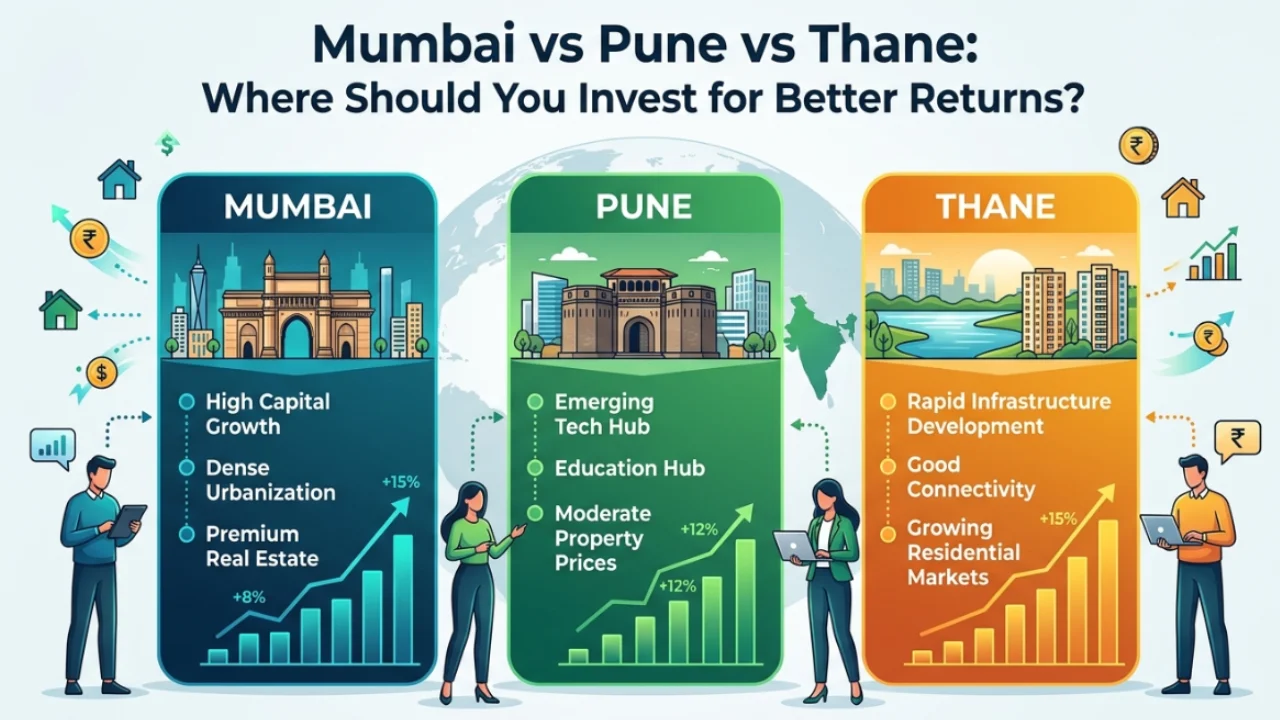
Finding a place to park your hard-earned money in India’s sprawling real estate sector is no small task when you’re looking at the west, and the “Golden Triangle” consisting of Mumbai, Pune, and Thane is likely at the top of that list. However, with our passage through 2026, the traditional rules of thumb associated with real estate investment have been undermined. For instance, with changing work culture, monumental infrastructure developments, and changes in the buying preference of Indians.
This guide to property investment comparisons between these three cities will help you determine which one will be right for you as a new homebuyer or an experienced investor.
Table of Contents
Mumbai Real Estate: The Spot for Elites
Mumbai real estate has long been the crown jewel of Indian property. It is a market defined by high stakes, global recognition, and unmatched corporate density.
The Strengths
Mumbai isn't just a city; it’s an economy. Its primary strength lies in capital preservation. If you buy in prime zones like Andheri, Powai, or Lower Parel, your asset is backed by:
-
High Liquidity: There is always a buyer or a tenant for a Mumbai property.
-
Corporate Hubs: Multinational giants ensure that commercial leasing remains robust, which trickles down to residential demand.
-
Resale Value: Historically, Mumbai properties hold their value even during national economic dips.
The 2026 Reality Check
The "City of Dreams" comes with a nightmare price tag. The property price difference between Mumbai, Pune, and Thane is most jarring here. Entry-level 2BHKs in core Mumbai suburbs often cost three times as much as a luxury villa in Pune.
Challenges for Investors:
-
Low Rental Yields: Expect a modest 2–3%. You’re playing for long-term appreciation, not monthly cash flow.
Market Maturity: Most "growth spurts" have already happened. While projects like the Coastal Road and Metro expansion add value, much of that profit is already "priced in" by developers.
Pune Real Estate: The Spot for Investors
If Mumbai is about "old money," Pune real estate is about "smart money." Once considered a quiet pensioner’s paradise, Pune has evolved into a high-growth investment engine.
Why Pune is the Best Place to Invest in Property 2026
Pune is currently in a "Goldilocks zone"—it’s developed enough to be reliable but young enough to offer massive growth. Micro-markets like Baner, Wakad, Hinjewadi, and Kharadi are the stars of the show.
-
IT & Education Growth: With the Hinjewadi–Mahalunge smart zone and expanded IT parks, the influx of high-earning young professionals is constant.
-
Superior Rental Yields: Investors often see 3–5%, significantly higher than Mumbai.
-
Lifestyle Quotient: Pune offers a family-friendly environment with better air quality and less congestion than its coastal neighbor.
Infrastructure Upside
Unlike Mumbai, where infrastructure often plays "catch-up," Pune is in the middle of a transformation. The Metro Phase 2 & 3 and the Pune Ring Road are opening up under-priced pockets. For an investor, buying in an "up-and-coming" Pune suburb today is like buying in Mumbai’s Andheri twenty years ago.
Thane: The Spot for Professionals
Often overshadowed by Mumbai, Thane real estate has carved out its own identity as a self-sustaining mega-city. Over the last decade, it has transitioned from an industrial zone to a premium residential hub.
The Growth Story
Thane is home to giants like Syntel, Clariant Chemicals, and Navnit Motors, providing jobs to over 60,000 people. But the real reason investors are flocking here is the infrastructure explosion.
Key Connectivity Drivers:
-
Thane–Borivali Underground Tunnel: Cutting travel time to minutes.
-
Wadala Metro Line 4: Connecting Thane directly to South Mumbai’s fringes.
-
Waterways and Bullet Train: Future-proofing the city's transport.
Thane offers a middle ground. It provides the "township living" that Mumbai lacks and the "corporate proximity" that Pune is still building. Real estate experts note that Thane has seen nearly 300% growth in the last five years in specific pockets—a trend likely to continue as the Katai-Airoli Freeway and Thane-Belapur Road further integrate the region.
Property Price Difference: Mumbai vs. Pune vs. Thane
What is the property price difference between Mumbai, Pune, and Thane? Let's look at the estimated entry points for a standard 2BHK apartment in 2026:
|
Feature |
Mumbai |
Pune |
Thane |
|
Avg. Entry Price |
₹2.5 Cr - ₹5 Cr+ |
₹80 L - ₹1.5 Cr |
₹1.2 Cr - ₹2.2 Cr |
|
Rental Yield |
2% - 3% |
3% - 5% |
3% - 4% |
|
Primary Driver |
Luxury/Finance |
IT/Manufacturing |
Connectivity/Service |
|
Growth Potential |
Stable |
High |
Moderate-High |
Which City Is Best For Property Investment?
So, where should I buy property: Mumbai, Pune, or Thane? The answer depends on your financial goals.
1. Choose Mumbai if...
You are looking for wealth preservation. If you have a large capital base and want a "safe haven" asset that will always be in demand, Mumbai’s premium micro-markets are unbeatable. It’s a prestige play with high capital stability.
2. Choose Pune if...
You want maximum ROI and Rental Income. Pune is the winner for mid-segment investors. With lower entry costs, you can often afford two properties in Pune for the price of one in Mumbai, diversifying your risk. The IT-led demand ensures your home will rarely sit vacant.
3. Choose Thane if...
You want the best of both worlds. Thane offers a "Mumbai-lite" experience—great infrastructure and brand-name developers, but with more space and slightly more affordable prices. It’s perfect for those who work in Mumbai but want a modern, township-style lifestyle.
Comparing the Three: At a Glance
When asking, "Where should I buy property: Mumbai, Pune, or Thane?" it helps to look at the numbers.
|
Feature |
Mumbai |
Pune |
Thane |
|
Entry Cost |
Very High |
Affordable/Mid-range |
Moderate |
|
Space |
Compact |
Spacious |
Modern & Balanced |
|
Best For |
Wealth Preservation |
High Growth/IT Pros |
Families/Commuters |
|
Rental Yield |
2-3% |
3-5% |
3-4% |
Conclusion
When we consider the Pune property market as we approach 2026 and the changing cityscapes in Thane and Mumbai, one thing is evident: connectivity has become the new currency for property investors. There is a continual shift from 'central' investments to 'connected' investments, and while Mumbai continues to remain the heart of India's economic activity, this is the area that has witnessed the most significant activity and growth in the last decade.
Last Tip: Look at RERA-registered projects only and consider the developer's history of timely delivery. In 2026, you should always prefer a 'ready-to-move' or a 'near-completion' property located within an area with a high degree of infrastructure development (such as Wakad in Pune) or along Ghodbunder Road in Thane, as this will provide the best return on your investment.