
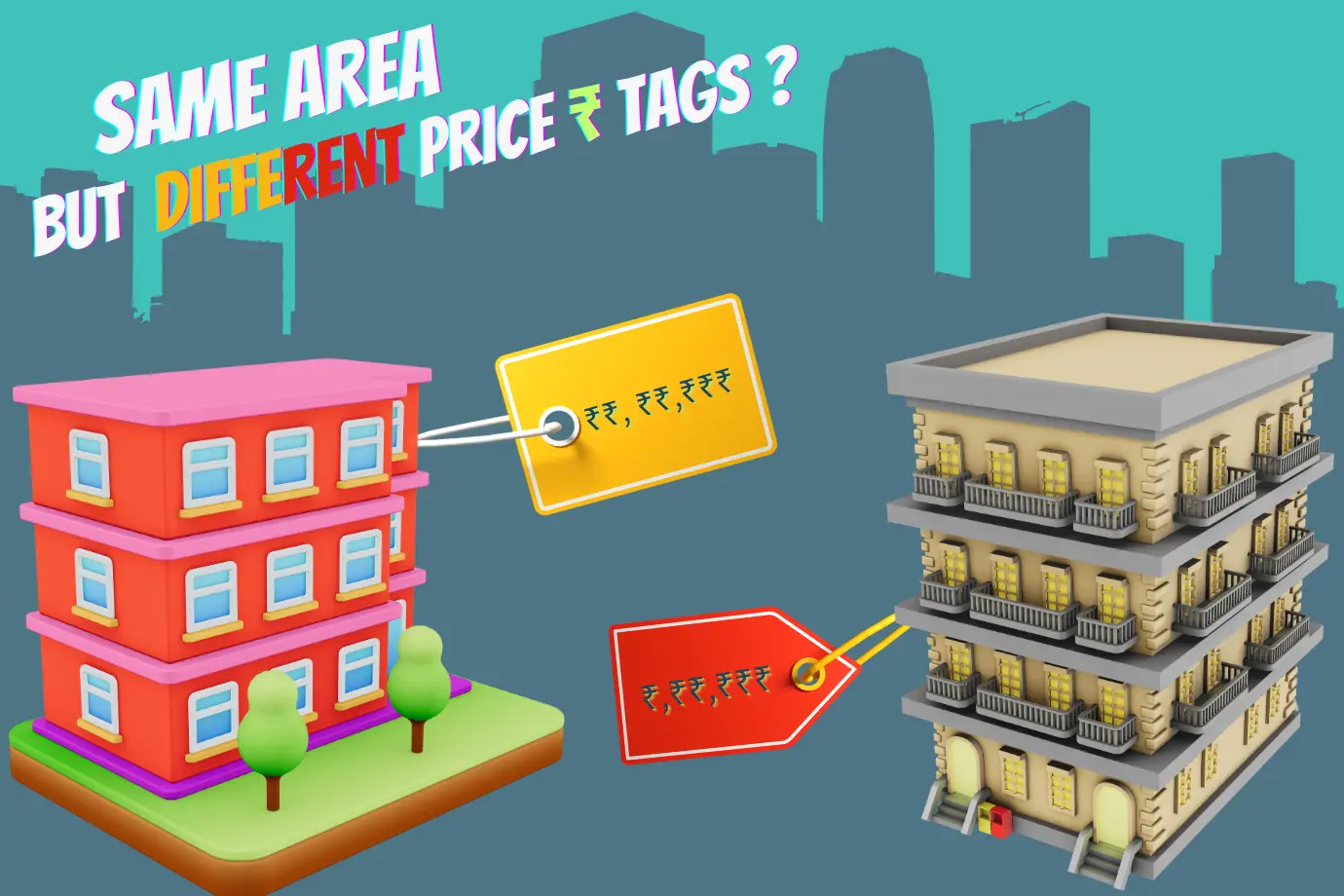
Before starting the blog let’s first look into the example below
You’ve shortlisted a housing project you like, only to discover that your friend bought a flat in the neighbouring society for ₹15 lakh less. Same sector. Same view. Almost the same carpet area.
So why the flat price difference?
It’s only natural to start questioning your decision and consider switching projects. But before you do, pause for a moment and understand what’s really behind property prices in the same locality. The truth is, real estate pricing isn’t as straightforward as it looks. Homebuyers don’t just pay for four walls and a roof they pay for an entire ecosystem a project offers or promises. Let’s break down the real property cost factors that explain why housing project prices can vary so drastically, even within the same area.
Table of Contents
Why Do Property Prices Vary in the Same Area?
From brand value to build quality, here are seven reasons that influence why property prices vary in the same area, even when projects are next to each other.
The Developer’s Reputation
One of the biggest drivers of housing project prices is the developer’s reputation. Buyers are willing to pay a premium for developers known for timely delivery, transparency, quality construction, and strong resale value. Call it the "trust tax," but in comparison to other projects in the same industry, a reputable builder with a spotless record, timely delivery, and strong resale value could easily command Rs 500–1000 per square foot, if not more.
Example:
Jaypee Aman and Ace Starlit are located within walking distance of each other. Yet, Jaypee Aman is priced at around ₹7,350 per sq ft, while Ace Starlit trends at ₹13,800 per sq ft. Same locality, similar views but a massive difference driven by brand perception and execution history.
Construction Quality
In India, reputable builders Larson & Turbo introduced Mivan shuttering, a modern building technique that dramatically improves durability while reducing construction time by 30–50%. And what else? Instead of constructing the walls brick by brick, this structure of recycled aluminum forms began casting full blocks of concrete at once, making the walls stronger and more resilient. In addition to construction quality, branded materials influence the unit's asking price. The entire cost of real estate increases when branded materials, such Grohe or Jaquar fixtures, are used in place of regional substitutes. These improvements might not seem like much on their own, but taken as a whole, they have an effect on the ultimate flat pricing. In these situations, the price difference is insignificant, yet it still contributes to the ultimate reported price.
Project Density
Two buildings may face the same park, but one may have four units per floor while the other squeezes in eight. Lower density means:
-
Less crowding
-
Better lift access
-
More privacy
Projects with fewer units per acre, wider corridors, better ventilation, and larger balconies are priced higher due to enhanced liveability, making density a crucial property cost factor. Instead of focusing on the number of units offered, the project's overall area might be used to map its density. Projects with 69 units per acre, for example, are often classified as low-density, though this classification may change depending on the project type or region. In addition, layout plans with larger balconies, greater airflow, or wider passageways are crucial in deciding their final cost.
Lifestyle Conviniences
Amenities like rooftop pools, co-working lounges, and landscaped gardens add value but only if they’re well-maintained. Projects with strong maintenance teams, efficient security, and active Resident Welfare Associations retain value better, which directly impacts property prices in the same locality. The problem is that a project with a lot of amenities needs a larger maintenance crew, therefore your monthly maintenance costs will likely go up. Check to see if the monthly regular costs are affecting your budget before being sucked into the ecosystem's maintenance.
Property Age
The ash brick construction is more common in housing societies that are ten years old, and most of these buildings struggle with normal wear and use. In terms of amenities or design, older ready-to-move-in properties could seem out of date when compared to recent releases. Infinity pools and double-heighted entry lobbies, for example, are popular right now, but you would scarcely find an old housing society with these amenities. In contrast, newer or under-construction projects may command higher prices due to better designs and stronger future returns making the property age a decisive factor in why property prices vary in the same area.
Legal Clarity
A simple title is far more powerful than a glitzy launch or beautiful brochure. Price reductions, festive promotions, or marketing hype may influence consumers. However, that "deal" can easily become a long-term issue if the land title is unclear or the enterprise has a history of litigation. Such properties are difficult to resell, banks are reluctant to fund them, and possession periods are protracted. On the other hand, a project that has all necessary approvals, no challenges, and a spotless RERA record can, and rightfully so, fetch a premium. You're paying for more than just the apartment; you're also paying for future liquidity, piece of mind, and the assurance that your investment won't freeze.
Micro-location perks
Micro-location refers to the exact position of your building, not the sector or even the street. Though one project may be directly on the main road and the other sits 300 meters inside, down a narrower path, both may view the same lake or park. Even though both theoretically have the same pincode, one may have a smoother entry point, a better approach road width, or easier access to everyday conveniences like supermarkets, schools, or metro stations. These daily conveniences play a big role in real estate pricing.
End Note
Flat price difference represents what the market values most—certainty, convenience, and confidence and are more than just numbers. Sometimes paying more is more about avoiding problems in the future than it is about having fun. So, when comparing housing project prices, don’t just look at the rate per square foot. Understand why the price exists. Because in real estate, what you don’t see can matter more than what you do. At Keystone Real Estate Advisory Pvt. Ltd, we give the best to our client, along with the best possible amenities and feature. If you are someone looking for property in mumbai or pune, get in touch with us today.
FAQ's
1. Why do property prices differ even within the same locality?
A: Property prices vary due to factors like building quality, amenities, floor level, view, carpet area efficiency, developer reputation, and project age.
2. Does the builder’s brand affect property pricing?
A: Yes. Homes developed by reputed builders often cost more because they offer better construction quality, timely delivery, and stronger resale and rental value.
3. Do amenities impact home prices in the same area?
A: Yes. Projects with premium amenities like clubhouses, swimming pools, smart security, and landscaped gardens usually have higher pricing compared to basic residential buildings.
4. Does floor level and view change property price?
A: Higher floors, better ventilation, open views, or sea/green views often increase property value, while lower floors or blocked views may be priced lower.
5. Does project age influence property price differences?
A: Yes. New or recently launched projects often cost more due to modern design, better facilities, and lower maintenance needs, while older buildings may be priced lower.
6. Do location advantages within the same area impact pricing?
A: Yes. Homes closer to metro stations, highways, schools, business hubs, or shopping centers usually command higher prices than properties located deeper inside the locality.