
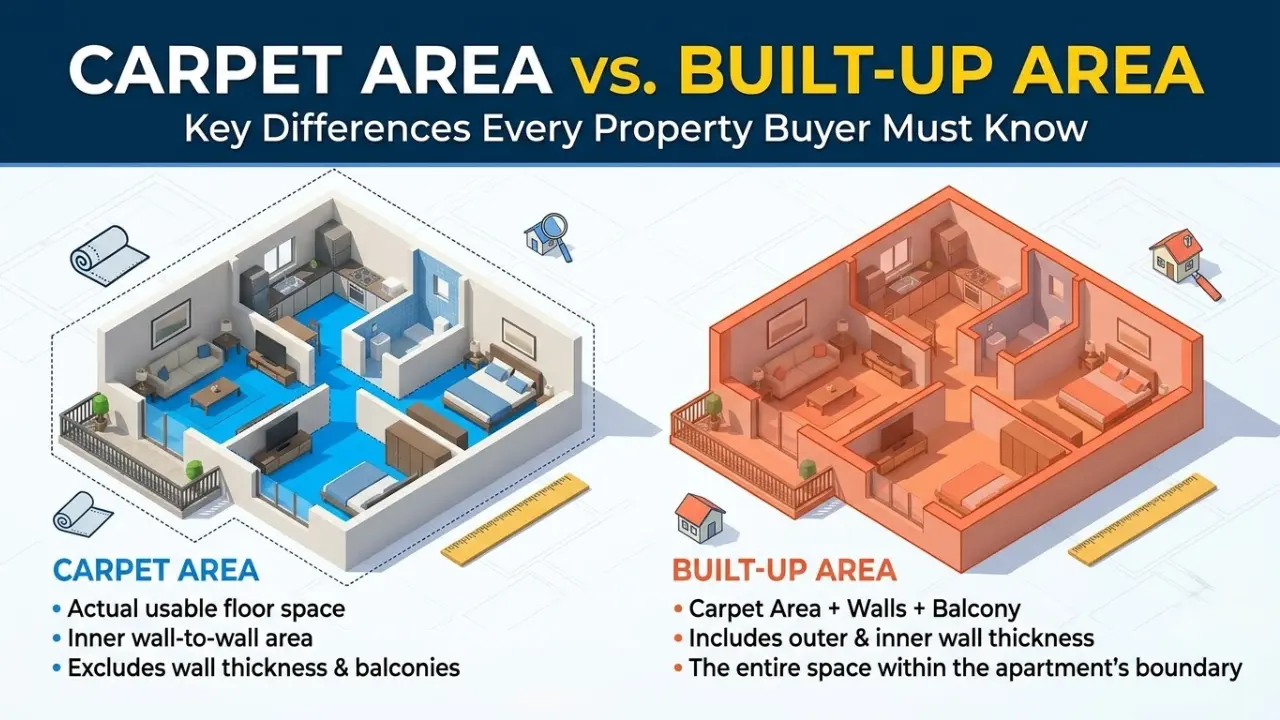
Choosing a home is about finding the right balance between your budget, location and the space you need. Understanding carpet area, built-up area and super built-up area helps you make that choice with a clearer picture of what you're buying.
Whether you're exploring flats in Mumbai or Pune, check the RERA carpet area, go through the floor plan and compare prices on the same basis. If a number in the brochure seems confusing, don't hesitate to ask questions.
After all, you aren't just buying a number of square feet. You're choosing a space where you'll live, spend time with family and build your future.
Table of Contents
Carpet Area Meaning
Carpet area is the part of the flat where you actually live. It’s where the bed, sofa, dining table and wardrobes go.
The carpet area meaning is fixed by the Real Estate (Regulation and Development) Act, 2016. It is the net usable floor area of an apartment. External walls, service shafts, exclusive balconies or verandahs and exclusive open terraces are not counted. Internal partition walls are counted.
Take two 2 BHK flats, one with 650 sq. ft. of carpet area and the other with 700. Fifty feet may not sound like much, but it can decide whether a wardrobe fits on that wall or whether you can walk past the dining table without squeezing.
Having said that, area isn’t the whole story. A smart layout in 650 sq. ft. can feel better than a clumsy one in 700. Carpet area is simply the fairest number to begin with.
Built-Up Area Meaning and What Is Super Built-Up Area
Built-up area is the term you’ll see most in listings. It comes out bigger than carpet area because it adds the walls, and sometimes balconies, depending on how the developer measures. So a flat with 650 sq. ft. of carpet area and about 100 sq. ft. of walls and similar items would show a built-up area of around 750 sq. ft. The gap changes from project to project, so ask how the builder arrived at the figure.
Now, what is super built-up area? Start with the built-up area and add your share of the common spaces in the building, like lift lobbies, staircases and shared passages.
A flat advertised at 900 sq. ft. super built-up might have only 650 sq. ft. of carpet area. You don’t get 900 sq. ft. to call your own. The rest is the share of space you use together with every other resident.
That’s the reason buyers get confused. A bigger number in the ad doesn’t always mean a bigger flat. If you’re ever unsure, ask the sales team this: “What’s the RERA carpet area of this flat?
Carpet Area vs Built-Up Area: Side by Side
|
Carpet Area |
Built-Up Area |
Super Built-Up Area |
|
|
What’s included |
Net usable floor area under RERA |
Carpet area plus applicable additional areas |
Built-up area plus a share of common areas |
|
Internal partition walls |
Included |
Generally included |
Included through the built-up part |
|
External walls |
Excluded |
Generally included |
Included through the built-up part |
|
Exclusive balcony |
Excluded |
May be included |
Generally included through the built-up part |
|
Common areas |
Excluded |
Generally excluded |
Generally included |
|
Why it matters |
Shows the legally defined usable area |
Gives a wider picture of the flat’s size |
Explains the saleable-area figure some developers quote |
Note: Built-up and super built-up calculations can vary. Always confirm the measurement basis with the developer.
The main point is to compare like with like. A flat of 900 sq. ft. on super built-up shouldn’t be weighed directly against a 750 sq. ft. flat on carpet area. They’re different yardsticks.
RERA Act 2016 Carpet Area Definition
Before RERA, every developer had a different idea of what “size” meant. The RERA Act 2016 carpet area definition changed that by giving buyers one legal reference.
Section 2(k) of the Act defines carpet area as the net usable floor area of an apartment, leaving out external walls, service shafts, exclusive balcony or verandah areas and exclusive open terraces. Internal partition walls stay in.
Before you book, find the carpet area in the project’s RERA registration details and compare it with the cost sheet and the draft agreement for sale. If the numbers differ, ask the developer to explain why, and ask for the answer in writing. You can look up project details on the official MahaRERA website, and the definitions sit in Section 2 of the Act.
Flat Area Calculation: A Simple Example
Flat area calculation sounds technical, but a small example clears it up. These numbers are only for illustration.
-
Carpet area: 650 sq. ft.
-
Walls and balcony (where applicable): 100 sq. ft.
-
Built-up area: 650 + 100 = 750 sq. ft.
-
Share of common areas: 150 sq. ft.
-
Super built-up area: 750 + 150 = 900 sq. ft.
The flat is the same in all three lines. You didn’t gain 250 sq. ft. of private room somewhere along the way. The larger numbers just count more things.
Real calculations depend on the layout and on the builder’s method, so don’t try to work out the gap yourself. Ask the developer for a proper breakdown of the area they quoted.
How to Check Flat Carpet Area in Mumbai
Buying a flat in Mumbai is probably the biggest purchase of your life, so this check is worth doing early, whether you’re looking in Andheri, Powai, Kandivali or Thane. Here is how to check flat carpet area in Mumbai.
-
Search the project on MahaRERA. Use the project name or registration number on the official portal, and read the details for the configuration you want.
-
Ask about your exact unit. One project can have several layouts, even within the same BHK type. Get the sales team to confirm the RERA carpet area of the specific flat you like.
-
Don’t rely on the brochure. Read the cost sheet and the draft agreement for sale. If the advertised area is larger than the carpet area, ask whether it’s built-up or super built-up.
-
Look at the floor plan. A flat can have decent carpet area and still feel tight because of how the rooms are arranged. Check the bedroom sizes, the kitchen and the living room.
If something doesn’t add up, ask for a written explanation before you pay any booking amount. If you’re still unsure, a qualified professional can go through the plans and measurements for you.
How to Check Flat Carpet Area in Pune
The process in Pune is almost the same, and it applies in Wakad, Baner, Hinjawadi, Kharadi, Hadapsar, and elsewhere. Don’t assume the advertised area is carpet area. This is how to check flat carpet area in Pune.
Find the project on MahaRERA and note the carpet area declared for your configuration. Then ask the developer for the floor plan and cost sheet of the unit you’re interested in. Two 2 BHK flats in the same project can have different carpet areas, so the bedroom count alone tells you very little.
Next, compare all of it with the draft agreement for sale. If the sales team’s numbers differ from the project documents, ask them to clarify before you go further.
One more thing: a larger carpet area doesn’t automatically mean a better home. Light, ventilation, room shapes and layout all affect how a flat feels day to day. Picture yourself living in it, not just reading the number on the brochure.
How Can I Calculate the Actual Price Per Square Foot of a Flat?
The carpet area also helps when you’re sorting out the budget.
Suppose Flat A costs ₹90 lakh with 600 sq. ft. of carpet area, and Flat B costs ₹95 lakh with 700 sq. ft. Flat A is cheaper overall. Is it cheaper for the space you get? Divide the price by the RERA carpet area to find out:
Price per sq. ft. = Total flat price ÷ RERA carpet area
-
Flat A: ₹90,00,000 ÷ 600 = ₹15,000 per sq. ft.
-
Flat B: ₹95,00,000 ÷ 700 = about ₹13,571 per sq. ft.
So Flat B costs ₹5 lakh more but gives you more space for every rupee. That’s the simplest answer to “How can I calculate the actual price per square foot of a flat?” Just use the same basis for every flat you compare.
This figure covers only the price of the property. Stamp duty, registration fees and other charges come on top, so add those separately when you plan your budget. And don’t pick a flat on this number alone. Location, construction quality, layout, amenities and possession date matter just as much.
Before You Book
-
Find out whether the advertised area is carpet, built-up or super built-up.
-
Check the RERA carpet area against the project documents.
-
Read the floor plan instead of going only by the BHK type.
-
Compare price per sq. ft. on carpet area for every flat on your list.
-
Get any difference in quoted area explained before you commit.
None of this takes long, and it can save you from a costly surprise.
FAQs
1. Why does the same 2 BHK flat look vastly different in size across different project brochures?
A: Developers often market properties using different area metrics. While one builder might advertise a flat using its larger super built-up area (which includes a share of common lobbies and staircases), another might quote the actual RERA carpet area. Always look for the RERA carpet area to compare actual usable floor space fairly.
2. What is the legal definition of carpet area under the RERA Act 2016?
A: Under Section 2(k) of the RERA Act 2016, carpet area is strictly defined as the net usable floor area of an apartment. It includes internal partition walls but explicitly excludes external walls, service shafts, exclusive open terraces, and exclusive balconies or verandahs.
3. Are internal walls and balconies included in my usable carpet area?
A: Internal partition walls are included in the carpet area calculation. However, external walls, service shafts, and exclusive balconies or verandahs are excluded from the core carpet area definition, though they may be factored into the wider built-up area.
4. How can I verify the authentic carpet area of a flat in Mumbai or Pune before booking?
A: Do not rely solely on sales brochures. Cross-check the project's registered configuration details on the official MahaRERA website, review the official cost sheet, and closely examine the developer-provided draft agreement for sale.