
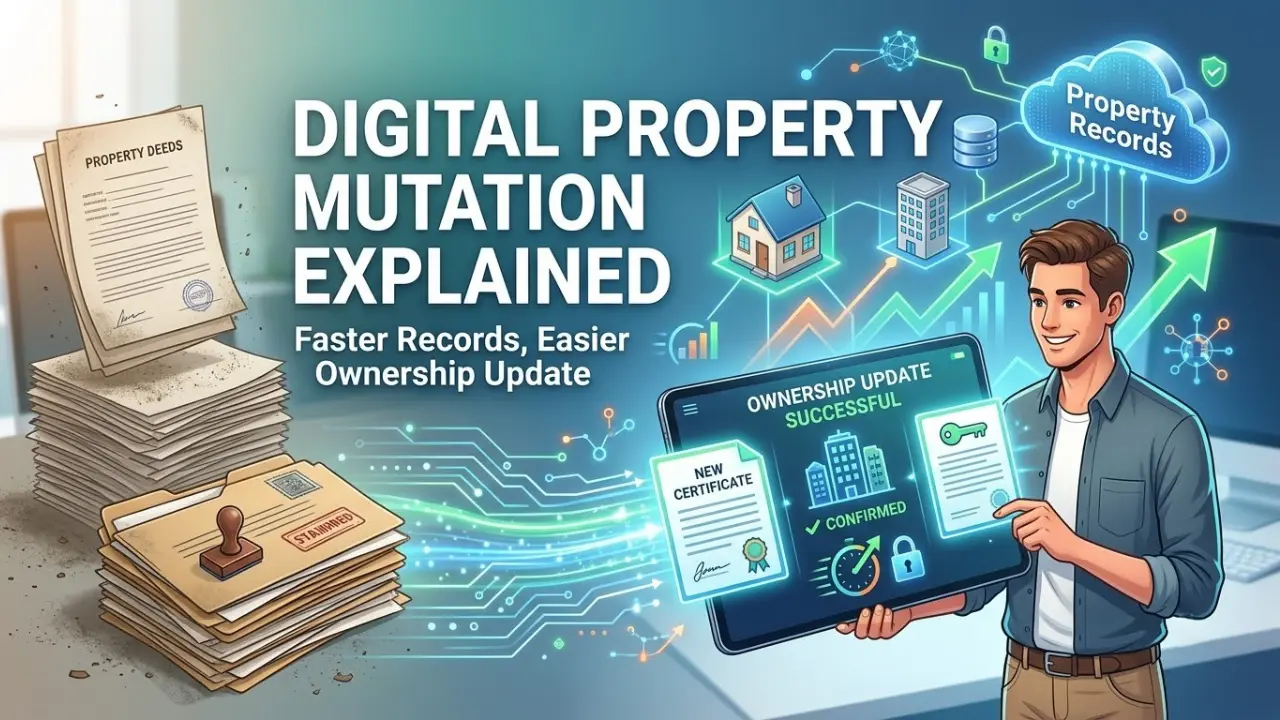
Anyone who has bought property in Mumbai knows the paperwork does not really end once the sale deed is signed and registered. There is another step that most first-time buyers either forget about or simply do not know exists, and that is property mutation. It sounds like a technical formality, and in a way it is, but skipping it can come back to you when property tax bills still show the previous owner's name or when a bank asks for updated records during a loan process.
The good news is that this step has gotten a lot easier over the last few years. Municipal bodies across Mumbai and the wider MMR region have moved much of the mutation process online, cutting down on the office visits that used to make this such a headache. Let us look at what property mutation actually means, how it plays out in Mumbai specifically, what paperwork you will need, and a few things people commonly get wrong about it.
Table of Contents
What exactly is property mutation
Property mutation is simply the process of updating the ownership record of a property with the local municipal or revenue authority. Every time a property changes hands, whether through a sale, inheritance, a gift, or a will, someone has to inform the local body so their tax and land records show the current owner rather than the old one.
It is worth pointing out early that this is a completely different process from registration, even though the two often get lumped together in people's minds. Registration happens at the sub-registrar's office and is what legally makes the sale official. Mutation happens later, at the municipal or revenue office, and it is really just about getting the paperwork on their end to catch up with reality.
How property mutation in Mumbai works
Within BMC limits, mutation for most residential and commercial properties is handled by the Brihanmumbai Municipal Corporation itself. Once your sale deed is registered and the property is legally in your name, you still need to separately apply to the BMC to have your name updated in their tax and assessment records. Nobody does this for you automatically, it has to be initiated by the new owner.
If your property falls outside BMC jurisdiction but is still within the greater Mumbai region, say in Thane or Navi Mumbai, then the respective municipal corporation there takes care of it instead. The steps are broadly similar wherever you are, though the exact forms and a few document requirements can differ slightly from one civic body to another.
Given how often properties in Mumbai change hands, whether through resale, inheritance within families, or investment purchases, it really helps to treat mutation as part of the closing process rather than something to get around to later. Records that are not updated tend to cause confusion down the line, especially if a property changes hands again.
What documents are required for property mutation

What you will need depends a bit on how the property was transferred, but for most sale-based transactions in Mumbai, you can expect to submit something like the following:
-
The registered sale deed or transfer deed
-
Your most recent property tax receipt
-
A filled and signed mutation application form
-
Identity proof such as an Aadhaar or PAN card
-
An indemnity bond on stamp paper, which some municipal offices ask for
-
A death certificate and legal heir certificate, in cases where the property is being transferred due to inheritance
-
A no objection certificate from the housing society, where applicable
-
A copy of the earlier mutation entry, if one exists for the property
It helps to have both hard copies and scanned versions ready before you start, since online applications usually want documents uploaded in specific file formats and sizes. Getting these ready in advance saves a fair bit of back and forth later.
Applying for online property mutation
The old way of doing this meant standing in line at the municipal office, sometimes more than once, and waiting weeks without much visibility into what stage your application was at. That has changed quite a bit now that most corporations, BMC included, allow mutation applications to be filed through their online citizen portals.
Broadly, the process looks like this. You visit the municipal corporation's website and log in or register on their citizen portal. From there you fill out the mutation application with your property and ownership details, upload the documents mentioned above, and pay the mutation fee online. Once submitted, you can track the status of your application through the same portal rather than having to call or visit the office to check.
Once it is approved, the updated ownership shows up in the property tax records, and most portals let you download a mutation certificate or extract directly, which is handy to keep on file.
Benefits of online property mutation for homebuyers
There are a few clear advantages to filing mutation online rather than the traditional way, and they matter more in a city like Mumbai where people's time is stretched thin.
You are not stuck taking a day off work just to sit in a queue at the municipal office. The whole thing can be done from your phone or laptop whenever you get a free hour. It is also a lot more transparent than before, since you can actually see where your application stands instead of wondering if it has been misplaced somewhere. Online forms tend to catch missing fields or obvious errors before you submit, which cuts down on applications getting rejected and having to be refiled. And because everything is digital, you end up with acknowledgement receipts and certificates that are easy to store and pull up later if needed, rather than a paper trail that can get lost.
Processing speed still depends on how busy the concerned office is, so it is not instant, but overall the online route tends to move faster than papers being physically routed between departments. For someone already dealing with a home loan, registration paperwork, and possession formalities all at once, having one less thing that requires an in-person visit makes a real difference.
Difference between property registration and mutation
This mix-up comes up a lot, especially with first-time buyers. Registration is the legal act of recording your sale deed at the sub registrar's office and paying the applicable stamp duty. It is what makes the transfer of ownership legally binding between you and the seller.
Mutation does not carry that legal weight. It is essentially an administrative update at the municipal end, done mainly so that property tax is billed to the right person going forward. One establishes ownership in the eyes of the law, the other just makes sure the civic body's own records are not out of date.
Both matter, just for different reasons, and mutation should ideally be taken care of soon after registration rather than left pending.
Does property mutation prove ownership?
This is probably the single most misunderstood part of the whole process. No, mutation on its own does not prove ownership. That proof comes from your registered sale deed or transfer document, not from the mutation entry. What mutation gives you is a revenue record, used mainly by the municipal body to figure out who to send the property tax bill to.
That said, having an updated mutation record does carry some practical value beyond tax purposes. It often gets asked for when applying for new utility connections, during loan processing, or when you eventually sell the property yourself. So while it is not a title document and should never be treated as one, keeping it updated makes the overall paper trail for your property cleaner and future transactions a bit smoother.
In short
If you have bought, inherited, or otherwise had a property transferred to your name in Mumbai, getting the mutation done should be near the top of your post-registration to-do list, not something you put off indefinitely. With most municipal corporations now offering this online, there really is not much reason to delay it anymore.
Keeping both your legal registration and your municipal mutation records current means fewer surprises later, whether that is a property tax notice, a loan application, or a future buyer asking questions during resale.