
Many of the homebuyers in India consider the core main thing to consider Vastu tips before buying a home. From the main to the kitsch and bedroom, every corner has its importance in Vastu Shastra.
For a lot of families, Vastu really does shape the final call. Some buyers ask about the main door before they’ve even seen the bedrooms. Others go straight to the kitchen or look for a spot where the pooja unit can sit. Small questions, sure, but they often decide which flat gets the booking amount.
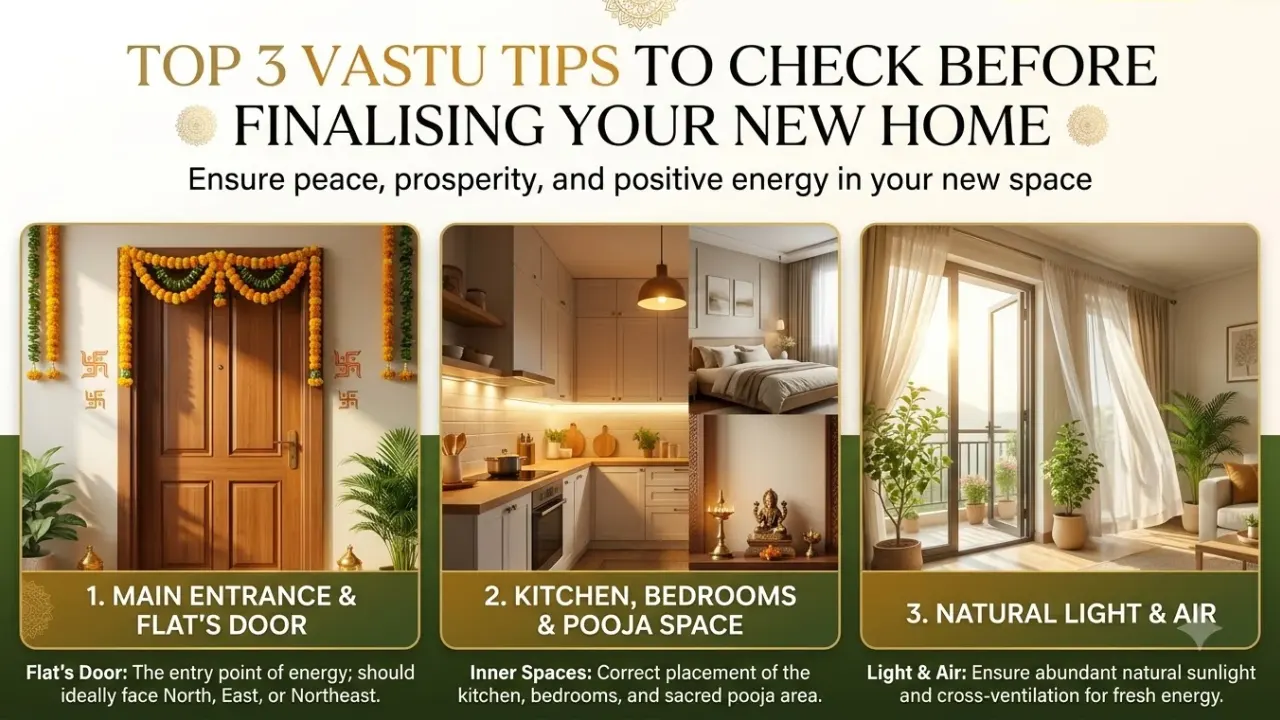
You don’t need to memorise Vastu rules to do this well. A floor plan, a phone compass and a bit of attention during the visit will get you most of the way. Here are the top 3 Vastu tips things worth checking first.
Table of Contents
1. Find out which way the flat’s door actually faces
Most Vastu-minded buyers start with the entrance. In traditional Vastu, north, east and northeast-facing doors are the favourites. Many interpretations accept the west too, and a south-facing door usually calls for a closer look at exactly where it sits.
Here’s where people slip up. The building and your flat’s door don’t have to face the same way. A tower might face east while your own front door opens towards the west or south. So if the brochure says “east-facing project", don’t take it to mean every flat inside is east-facing. Ask about your specific unit. Open a compass app on your phone, or get the sales advisor to walk you through the orientation on the floor plan.
While you’re standing there, notice the rest of the entrance area too. Is the corridor well lit? Does the door swing open without hitting a wall? Does it open into a tight corner? Some Vastu practitioners also advise against a staircase, a lift or a neighbour’s door sitting right opposite yours. If that matters to your family, look for it now. It’s a lot easier than discovering it after possession.
2. Look at where the kitchen, bedrooms and pooja space sit
Once the entrance passes, move to the layout inside.
The southeast corner is traditionally seen as the right place for a kitchen, with northwest as the second option. Some guidelines also say the person cooking should face east. For the master bedroom, southwest is the usual preference. Children’s rooms and guest rooms are often placed in the west or northwest, depending on the plan.
The pooja space ideally goes in the northeast. In reality, plenty of Mumbai flats simply don’t have the room for a separate pooja room, so families end up fitting a compact mandir unit into the living room. That’s very common and perfectly workable. As for toilets, northwest and west are the commonly suggested spots, while the northeast and the centre of the flat are discouraged.
Now the honest part. It’s rare to find a flat that ticks every box. A compact 1BHK leaves the developer very little to play with, and even in bigger homes you’ll often find one room placed beautifully and another that isn’t. That’s why it helps to decide your non-negotiables before you start visiting. Maybe it’s the kitchen. Maybe it’s the master bedroom.
Ask the developer for a floor plan with north clearly marked, and check each room against it. Don’t judge by the sample flat alone. If Vastu matters a lot to you, you can have a consultant review the plan before you commit.
3. Don’t stop at directions: check light and air
A flat can look lovely in a brochure and still feel gloomy when you step inside. Directions are only part of the story.
Try to visit in the morning so you can see how much daylight actually comes in and whether air moves through the rooms. Traditional Vastu also likes open, uncluttered space, especially in the northeast, and it treats the centre of the home (the Brahmasthan) as an area that should stay fairly open. Look at the plan for anything that blocks these zones. Room shapes matter in this tradition as well. Squares and rectangles are favoured, and odd shapes or missing corners are seen as less desirable.
And this one is very Mumbai. Say you book an east-facing flat for the morning sun, and then discover another tower standing a few metres from your windows. The direction is right, but the sunlight never arrives. So go to the window and look out. How far is the next building? What’s the view like? Is there any open space nearby?
Ventilation matters even more here. With our humidity and heavy monsoons, a stuffy room becomes uncomfortable quickly. Whether or not you follow Vastu, you’ll be glad you checked this once you’ve moved in.
How to identify a Vastu-friendly flat
Get the floor plan before you visit, and make sure it shows north, the main entrance, the kitchen, the bedrooms and the toilets. At the site, compare the real layout with the drawing. Sample flats are styled to look their best, so the furniture and finishes can make the space feel different from what you’ll actually receive.
Then write down what you won’t compromise on. For one family it’s the door direction. For another it’s the kitchen or the master bedroom. Having that conversation at home first saves you from rejecting a flat at the last minute over something you could have checked earlier. If you’re stuck between two or three options, a Vastu consultant can help you see the differences.
Just don’t lose sight of the basics: carpet area, construction quality, connectivity and total cost. A flat has to work for your daily life, not only on paper.
Finding Vastu-compliant flats in Mumbai
Be ready to be patient. Space is tight in this city, and developers have to work around plot shapes, building rules and the need to use every square foot. You may not get a flat that suits your Vastu preferences and also meets your other needs.
You might find an apartment with the perfect entrance and kitchen, but the carpet area is smaller than you hoped. Another might be bigger and better connected, yet the layout doesn’t match what you wanted. That’s the moment your priority list earns its keep.
If you’re looking at a new project, ask whether flats with different orientations are available. Larger projects with multiple wings and floors often give you more layouts to compare, though it depends on the actual design and what’s still unsold. Tell your property advisor about your Vastu preferences at the very start. It saves you from spending Sundays at flats that were never going to work.
Vastu shouldn’t be the only thing you go by, though. Before you book, check the legal documents, the approvals and the MahaRERA registration where applicable. Look at the possession timeline, make sure the price suits your budget, and talk to a legal professional before you sign the agreement.
Also, be wary of anyone who promises that one simple remedy will fix every Vastu problem. Practitioners often disagree with each other, and no remedy replaces looking carefully at the layout yourself.
Final thoughts
Wanting a home that fits your family’s beliefs is completely reasonable. Check the entrance, look at where the key rooms fall, and spend a little time judging the light and air. That’s a solid starting point. If you’re searching for Vastu-compliant flats in Mumbai, get the floor plan early and be clear about what matters most to you. It makes comparing properties much simpler without losing track of budget and location.
In the end, you’ll be living there for years. Take your time, ask plenty of questions, and pick a place that works for you in every way, not just on the compass.
Browse verified project listings and Vastu-compliant projects on the Keystone Real Estate Advisory portal.